Caveats:
1) I’m too old and poor to try and hear everything anymore. I’m sure I’d dig FKA twigs and maybe even enjoy Taylor Swift’s new record, but my attention has been focused elsewhere. I buy what I like, and sometimes fate brings me new music that I find I like too.
2) I didn’t even get to hear everything that I do like. I enjoyed Pallbearer’s debut but haven’t heard “Foundations of Burden” yet. There’s a lot more I heard once or twice in a stream, but haven’t revisited. The biggest name here would be Afghan Whigs, “Do To the Beast.” No doubt it would be on this list if I had a chance to dig in further but somehow I haven’t.
3) This is a snapshot of December 2014. Catch me on a different day and I’ll be talking about different records.
4) I consume most of my music in the car or, more often, while running. That means I favor up-tempo records with strong melodies and rhythms. I appreciate other music, too, but my running means I’ve got a bias that’s reflected here.
With that:
15. Primordial – “Where Greater Men Have Fallen”
Primordial’s newest album, and the third I’ve dug into, came out late in November so I haven’t had the chance to fully digest it. For me, Primordial occupies the spot Amon Amarth used to hold down: solid, competently-played metal with heroic overtones that makes me feel like slaying a dragon. Primordial plays with more soul than Amon Amarth and has a better hit-to-miss ratio, but it’s similar in that there’s not a whole lot of variation between albums. Doesn’t mean it’s not good stuff.
14. Aby Ngana Diop – “Liital”
African funk music, particularly of the “Nigeria ’70” variety, has taken an increasingly larger proportion of my listening the last couple of years. I got introduced to the Awesome Tapes From Africa label through a BBC audio documentary, and this was the first album I picked up. Aby Ngana Diop’s got a siren of a voice, matching and at times overwhelming the percussive accompaniment and backing singers.
13. Sun Worship – “Elder Giants”
Like African funk, black metal has taken a greater share my listening space in 2014 than in the past. Sun Worship’s “Elder Giants” attracted my attention because it was free, then held it because of its burning, trancey melodies and savage riffs.
12. Mac DeMarco – “Salad Days”
For a couple of years in the earliest 2000s my favorite band was Ween. I caught it during the back half of its peak, before Gene and Dean started trying to write more serious pure pop songs. Mac DeMarco basically writes versions of the catchiest Ween songs from that period (think “Chocolate & Cheese” through “Quebec”), but because he doesn’t share billing with a co-collaborator he’s free to progress in ways that Gene and Dean were not. I’m eager to hear what he does over the next few years.
11. Röyksopp & Robyn – “Do It Again”
Robyn’s “Body Talk” remains my favorite pop record of the past few years. Every song sounds like a single, and it still holds up in 2014. On “Do It Again” she took a different tack, collaborating with Röyksopp to produce an EP that sounds like more of a proper “serious” electronic album while still including bangers like the title track.
10. Death – “Leprosy”
I hesitate to include reissues, but here we go anyway. “Leprosy” is my favorite Death album, mixing the savagery of its first record with just a hint of the progressiveness to come. I rank it this low only because the reissue improves on the original, but only marginally. The demos that come with the 2-CD version are OK; the live material on the 3-CD version is better but not essential.
9. Nightfell – “The Living Ever Mourn”
This Portland band feels almost generic in the way it incorporates so many standard elements of metal—but it plays them so well it elevates the album. Hardly a minute goes by without something awesome happening, and it’s hard to ask much more than that. For a brief, 2-week window this was my favorite album of the year.
8. Mastodon – “Once More Round the Sun”
Mastodon’s first four albums are unfuckwithable. Even “Crack the Skye,” which represented a noticeable softening in the band’s sound, remains essential in that it drove the Georgia sludgesters in new directions while crafting a cosmic enigma of a concept album. I didn’t dig “The Hunter” at all, but “Once More Round the Sun” feels like a return to form. It’s not quite on the level of those first four, but it’s a consistently fun listen that proved one of my albums of the summer.
7. Fugazi – “Roanoke, VA USA 4/13/96”
What a cheat. This was recorded 18 years ago and isn’t a 2014 album in any sense except that Dischord happened to release it this year. And yet. I’d heard some negative things about this show—that it was disappointing, didn’t live up to expectations, and so on—but in reality it serves as a tightly wound example of Fugazi at its best. I can feel these guitar lines like an electric shock, and even though it was disappointing to hear Guy Picciotto confuse Roanoke with the lost colony, Ian MacKaye makes up for it by revealing the band ate at Macado’s.
6. Inter Arma – “The Cavern”
I included Inter Arma’s “Sky Burial” in my Favorite Music of 2013 list, but that’s an album that really worked as a slow burn for me. It took me multiple listens, well into this year, before I really got it as a longer work of music with multiple movements. “The Cavern,” written early in the band’s career but not recorded and released until 2014, feels much more immediate. Maybe it’s the fact it’s presented as one long track, but it feels cohesive and epic in a much more obvious way than “Sky Burial.” That doesn’t mean it’s better, exactly, but I do feel it will do more to establish the Richmond band’s reputation. Call it the “Dopesmoker” effect.
5. Nux Vomica – “Nux Vomica”
This is an album I threw on for the first time during a run, and I feel like my ears traveled as far as my feet. Nux Vomica, now defunct, built numerous digressions and stylistic shifts into three tracks on its self-titled album, infusing crust, hardcore and death metal with soaring melodies. This is exactly what I want when I run: A rhythm section that keeps my legs moving while the melodic portions take my head into the stratosphere.
4. Blut Aus Nord – “Memoria Vetusta III – Saturnian Poetry”
In some ways Blut Aus Nord could have held a higher position, but I chose to go by album rather than my experience with the band. This year I listened quite a bit to “777 – Cosmosophy,” an experimental take on industrial metal, and “The Work Which Transforms God,” which apparently jumpstarted the trend of mixing shoegaze with black metal. It’s the “Memoria Vestusta” series that defines Blut Aus Nord for me, though—soaring second-wave-inspired black metal that plumbs the reaches of the cosmos. I haven’t fully processed this album just yet, but find myself getting lost in the majesty and chaos. That’s good enough for now.
3. Run the Jewels – “Run the Jewels II”
Run the Jewels appeared on last year’s list, but what a difference a year makes. I found the first RTJ album interesting, but it paled in comparison to Killer Mike’s “R.A.P. Music.” RTJ2 stands on its own merits, mixing crazy beats with some of the best vocal work that Killer Mike & El-P have done yet. The whole thing is engaging and grabbed my attention from the get-go. And it makes a killer running soundtrack.
2. Sturgill Simpson – “Metamodern Sounds in Country Music”
So, on a long drive west from Virginia to Iowa, I tweeted that I was listening to Chris LeDoux, a primary inspiration for Garth Brooks (in the best way possible) and one of my late ‘90s favorites. Michael Fortes responded by asking if I’d heard Sturgill Simpson’s new record. I hadn’t, but asked a record clerk in Kansas City about this album. She absolutely melted. At first I tagged Simpson as a Waylon Jennings clone playing revivalist outlaw country—there are far worse genres to revive than that one—with some Pink Floydy instrumental flourishes. Subsequent listens reveal something a bit deeper, as Simpson could have fit into that original outlaw movement and held his own quite nicely.
1. Ex Hex – “Rips”
Mary Timony has for years stood as one of my all-time favorites, a consistent chartreuse too often overlooked among the indie rock greats. Wild Flag, her collaboration with Carrie Brownstein, held promise but too many fans expected Sleater-Kinney 2.0 and compared her unfavorably to Corin Tucker. What a fallacy. Timony deserves to be judged on her own merits. With Ex Hex, she’s somehow taken her own, steady brand of progressive indie rock and grafted it onto a garage template for a style of music that represents a throwback and look at the future simultaneously, preserving her unique musical style while also moving it forward with a catchier, more immediate style. Perfection. My only hesitation in naming this my Album of the Year is that I see so much room for progression and further improvement.
Best album from 2013 discovered this year: Cult of Fire “मृत्यु का तापसी अनुध्यान”
My early 2014 was littered with 2013 albums I didn’t discover until after writing this post last year. Agrimonia’s “Rites of Separation” was one of my favorite albums all year, and a sibling to Nux Vomica in style. Ultimately, however, I listened more to “मृत्यु का तापसी अनुध्यान,” a killer mix of black metal, trancey eastern passages and instruments and catchy, memorable songs. It’s one of those records where I’d find the songs stuck in my head and had to think for a bit before I remembered the source.
Throwback, Best Album of 1994: Bjork – “Post”
I still remember the day I bought Bjork’s “Post.” It was one of the few albums I bought the day it came out—June 13, 1995—at a record store in the shopping center at the top of the University of Rhode Island, where I was visiting for orientation and would spend the next four years. I’d mixed Bjork’s earlier album, “Debut,” into my listening mix during my junior and senior years in high school, but “Post” took it to a whole new level. I wore this album out at URI, especially that freshman year. In the longview, I think 2001’s “Vespertine” is probably the superior album and Bjork’s master work, but “Post” brings back so many memories and still serves as my favorite album from her and from 1995.
Past:
Best of 2013: Subrosa “More Constant Than the Gods”
Best of 2012: Converge “All We Love We Leave Behind”
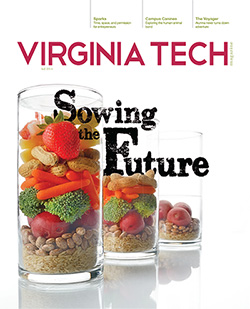 Virginia Tech Magazine has released its Fall 2014 issue, which includes several of my stories.